SFJD-Net: spatial-frequency domain joint feature enhancement with differential learning for brain stroke segmentation
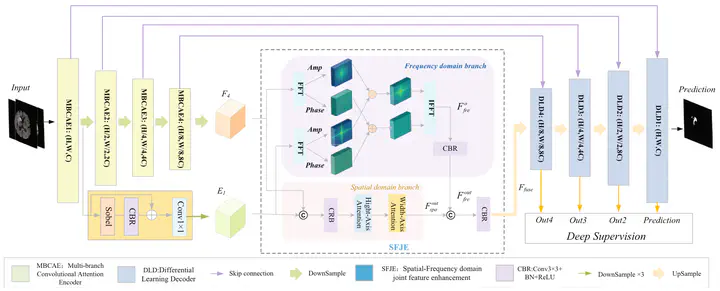 Image credit: Applied Intelligence
Abstract
Brain stroke is a major cause of disability and death, and accurate lesion segmentation is essential for early diagnosis and treatment planning. Although CT and MRI provide critical diagnostic information, the large variations in lesion appearance and the noise introduced by manual annotations make precise segmentation challenging. To address these issues, we propose SFJD-Net, a novel Stroke lesion segmentation network that leverages joint spatial-frequency domain feature enhancement and differential learning. SFJD-Net consists of three core modules: Multi-Branch Convolution Attention Encoder (MBCAE), Spatial-Frequency domain Joint feature Enhancement (SFJE), and Differential Learning Decoder (DLD). Compared with the traditional U-Net architecture, SFJD-Net introduces shallow edge information into deep semantic features to enhance texture and boundary representation. The MBCAE module adaptively captures multi-scale lesion features to enrich representations. The SFJE module enhances feature representations from both the spatial and frequency domains, which integrates positional cues and structural details to guide the network in focusing more accurately on target regions. The DLD module uses the reconstructed convolution kernel to record the differences between encoder and decoder, and integrates it into the decoding process through convolution operation, which reduces the semantic gaps and the probability of misjudgment of decoder. Extensive experiments on the published Ischemic Stroke Lesion Segmentation (ISLES) 2022 and 2018 datasets demonstrate that our method achieves state-of-the-art performance. In addition, SFJD-Net is successfully migrated to the pancreas cancer segmentation task of the MSD Cancer dataset, which fully proves that the network has a certain generalization ability.
Xin Huang 黄鑫
Master.
A Master student of this laboratory, research interests include Artificial Intelligence, Web and Deep Learning.

Yu Zhu 朱煜
Professor. Experts in artificial intelligence and computer vision. Lab leader.
Leader of this laboratory, research interests include Artificial Intelligence, Computer Vision, Industrial controls, Digital Image and Video Processing, Machine learning, Deep Learning and Applications.
Yatong Liu 刘雅童
PhD.
A doctoral student of this laboratory, research interests include Medical Image Processing, Deep Learning Algorithm and Multi-source Medical Image Intelligent Analysis.