 Image credit: Displays
Abstract
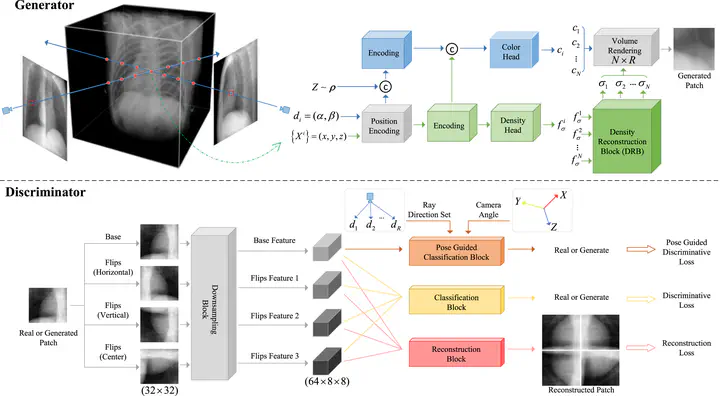
In clinical diagnosis, doctors usually judge the information by a few X-rays to avoid excessive ionizing radiation from harming the patient. The recent Neural Radiance Field (NERF) technology contemplates generating novel-views from a single X-ray to assist physicians in diagnosis. In this task, we consider two advantages of X-ray filming over natural images: (1) The medical equipment is fixed, and there is a standardized filming pose. (2) There is an apparent structural prior to X-rays of the same body part at the same pose. Based on such conditions, we propose a Pose-Guided generative radiance field (PGgraf) containing a generator and discriminator. In the training phase, the discriminator combines the image features with two kinds of pose information (ray direction set and camera angle) to guide the generator to synthesize X-rays consistent with the realistic view. In the generator, we design a Density Reconstruction Block (DRB). Unlike the original NERF, which directly estimates the particle density based on the particle positions, the DRB considers all the particle features sampled in a ray and integrally predicts the density of each particle. Experiments comparing qualitative-quantitative on two chest datasets and one knee dataset with state-of-the-art NERF schemes show that PGgraf has a clear advantage in inferring novel-views at different ranges. In the three ranges of 0°to 360°, -15°to 15°, and 75°to 105°, the Peak Signal-to-Noise Ratio (PSNR) improved by an average of 4.18 decibel, and the Learned Perceptual Image Patch Similarity (LPIPS) improved by an average of 50.7%.

Hangyu Li 李航宇
PhD. Super listener of 《三国恋》🎵.
A doctoral student of this laboratory, research interests include Neural Radiance Fields, Medical Image Processing and Generative Model.
Moquan Liu 刘墨泉
Master.
A Master student of this laboratory, research interests include Artificial Intelligence, 3D Reconstruction in the Medical Field and Deep Learning.

Mengcheng Sun 孙梦成
Master.
A master student of this laboratory, research interests include Artificial Intelligence, Medical Image Reconstruction and Super-resolution Reconstruction.

Yu Zhu 朱煜
Professor. Experts in artificial intelligence and computer vision. Lab leader.
Leader of this laboratory, research interests include Artificial Intelligence, Computer Vision, Industrial controls, Digital Image and Video Processing, Machine learning, Deep Learning and Applications.