Fine-grained grading network based on sparse transformer and spectral attention for multiparametric MR image segmentation
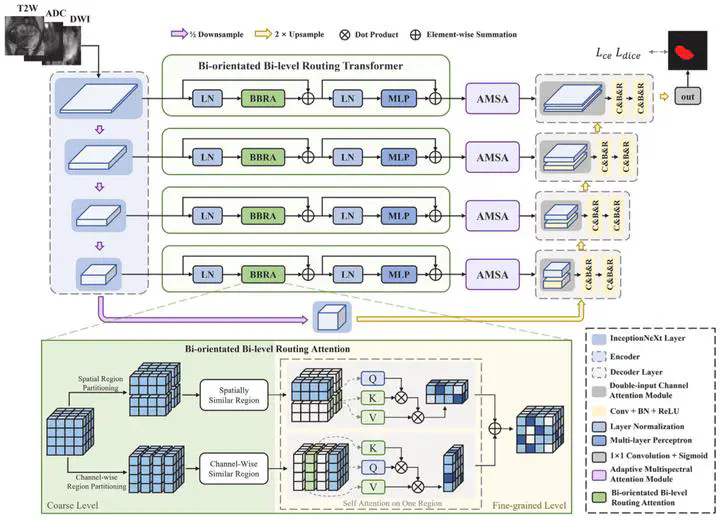 Image credit: Elsevier
Abstract
Multiparametric magnetic resonance imaging (mpMRI) is crucial in excluding serious diseases by providing clear scans that can quickly locate diseased tissue. Subjective assessment of lesion aggressiveness can vary among clinicians. We propose a network for mpMRI segmentation capable of effectively segmenting fine-grained lesion groups in prostate cancer (PCa), with potential applicability to other magnetic resonance imaging (MRI) segmentation tasks such as brain strokes. Specifically, a bi-oriented bi-level routing transformer (BBRT) with a flexible sparse attention mechanism is designed to enhance the network’s target perception. This design optimizes the Transformer’s long-range modeling capabilities. An adaptive multispectral channel attention (AMSA) module with an automatically selected frequency components mechanism is designed to enhance target contour recognition accuracy. It improves the network’s sensitivity to detect crucial texture information. Experiments are conducted using three MRI datasets. Our method achieved a dice similarity coefficient (DSC) of 76.09% for grading PCa on PCAMM, demonstrating improvements of 2.77%, 3.79%, 3.64%, and 0.29 % over the suboptimal method in clinically significant Gleason score (GS) groups (GS 3+4, GS 4+3, GS=8, and GS≥9), respectively. The prostate region segmentation obtained DSC of 94.03% and 84.52% for the central gland (CG) and peripheral zone (PZ), respectively, on PROSTATEx. The stroke segmentation achieved a DSC of 86.33% on ISLES2022. The experimental results demonstrate that the proposed model excels in generalization and outperforms other state-of-the-art methods.

Yatong Liu 刘雅童
PhD.
A doctoral student of this laboratory, research interests include Medical Image Processing, Deep Learning Algorithm and Multi-source Medical Image Intelligent Analysis.

Yu Zhu 朱煜
Professor. Experts in artificial intelligence and computer vision. Lab leader.
Leader of this laboratory, research interests include Artificial Intelligence, Computer Vision, Industrial controls, Digital Image and Video Processing, Machine learning, Deep Learning and Applications.

Hangyu Li 李航宇
PhD. Super listener of 《三国恋》🎵.
A doctoral student of this laboratory, research interests include Neural Radiance Fields, Medical Image Processing and Generative Model.